 By Legal Radar
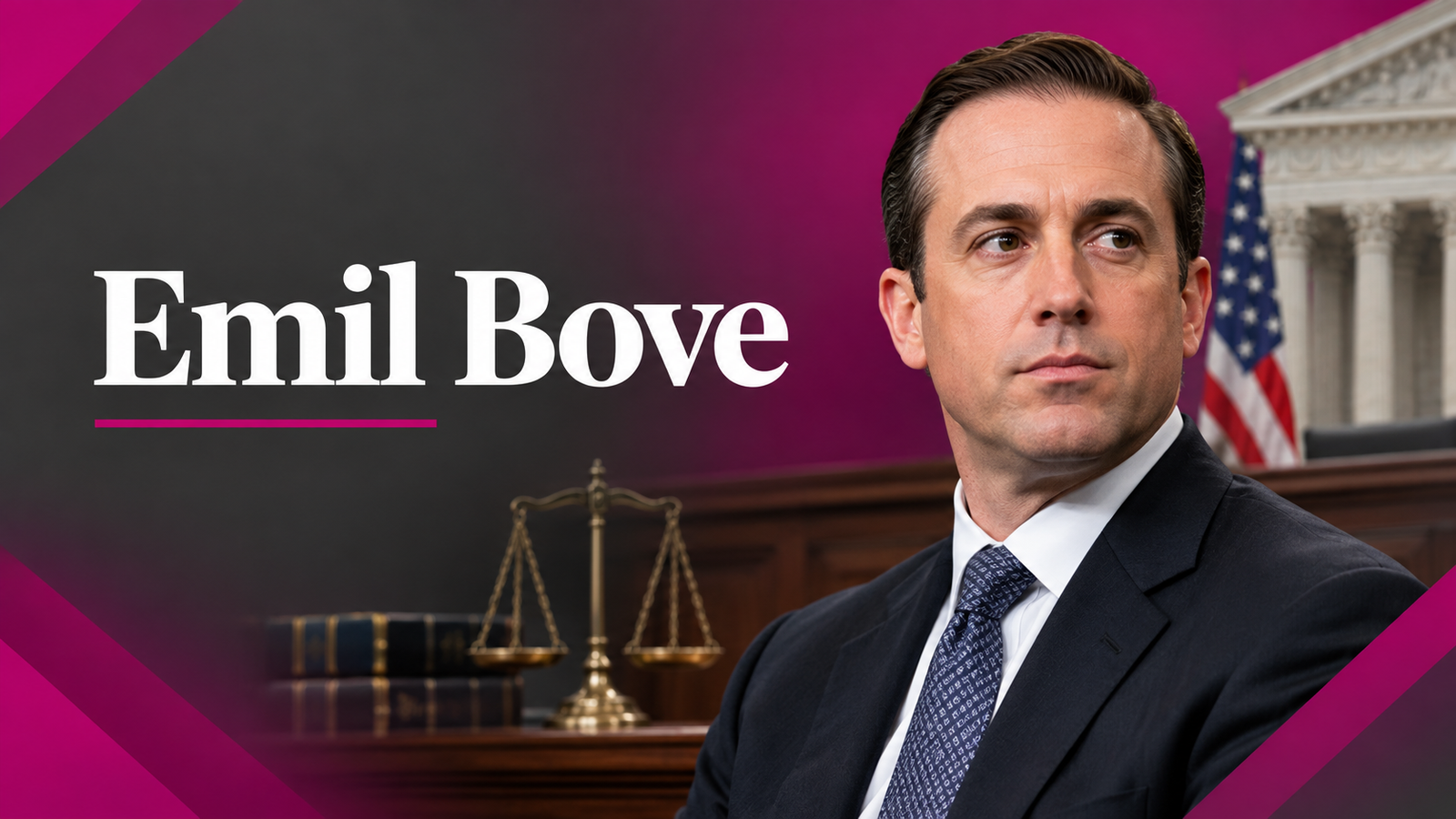
Federal judicial appointments often spark debate about qualifications, independence, and the role of prior political service. Few recent nominees have drawn as much attention as Emil Bove. From Assistant U.S. Attorney in the Southern District of New York to defense counsel for Donald Trump and a senior Department of Justice official, Bove’s path led to confirmation as a judge on the U.S. Court of Appeals for the Third Circuit.
This guide examines his education, prosecutions, private practice work, DOJ tenure, and the controversies that surrounded his judicial nomination. It aims to give legal professionals, analysts, journalists, and students a clear, factual overview of his career and the issues that defined his rise.
Early Life, Education, and Path to the Law
Emil Joseph Bove III was born in 1981 in Geneva, New York. He graduated as salutatorian from Mynderse Academy and attended the State University of New York at Albany. There he earned a bachelor’s degree in public policy and economics in 2003, graduating summa cum laude. He captained the men’s lacrosse team and was named America East Conference Male Scholar-Athlete of the Year.
After college he worked as a paralegal in the Southern District of New York. He then attended Georgetown University Law Center, earning his J.D. in 2008. At Georgetown he served as editor-in-chief of the Annual Review of Criminal Procedure.
Bove completed two federal clerkships. He first clerked for Judge Richard J. Sullivan of the U.S. District Court for the Southern District of New York (2008–2009). He then clerked for Judge Richard C. Wesley of the U.S. Court of Appeals for the Second Circuit (2009–2010). Both judges were appointed by President George W. Bush.
After his clerkships he joined the New York office of Sullivan & Cromwell as an associate, practicing from roughly 2010 to 2012.
Career as a Federal Prosecutor in the Southern District of New York
In 2012 Bove returned to the Southern District of New York as an Assistant U.S. Attorney. The office is widely regarded as one of the most prestigious federal prosecutorial posts in the country. He focused on narcotics, terrorism, and national security matters.
In 2019 he served as acting deputy chief of the Narcotics Unit. Later that year he became co-chief of the Terrorism and International Narcotics Unit, a position he held until 2021.
Notable Prosecutions and Cases
Bove participated in or supervised several high-profile matters. These included:
- The drug-trafficking case against the brother of then-Honduran President Juan Orlando Hernández. The defendant was convicted on drug and weapons charges.
- Work connected to the indictment of Venezuelan President Nicolás Maduro on drug-trafficking charges.
- The prosecution of Cesar Sayoc, who sent pipe bombs to prominent Democratic figures and critics of Donald Trump.
- Cases involving terrorism support and international narcotics trafficking.
He also had a role in investigations related to the January 6, 2021, attack on the U.S. Capitol.
Internal Criticisms and the Nejad Case
Bove’s management style drew internal complaints. Colleagues and defense attorneys described him as aggressive and, at times, abrasive. In 2018 a group of federal defense attorneys raised concerns with SDNY supervisors about his conduct.
A significant controversy arose from the prosecution of Iranian banker Ali Sadr Hashemi Nejad on sanctions-related charges. As a supervisor, Bove oversaw the case. The district judge later found that prosecutors had failed to disclose potentially exculpatory evidence in a timely manner and had made inaccurate representations to the court. The judge described “grave derelictions of prosecutorial responsibility” and criticized the level of supervision. Text messages later made public showed Bove acknowledging that the team had told a “flat lie” to the court. The government ultimately dismissed the case after the jury verdict, determining that further prosecution was not in the interests of justice.
Internal leadership reviewed complaints about Bove’s supervisory style around 2020–2021. Reports indicate that demotion was considered but not carried out. Bove left the office in December 2021.
Private Practice and Representation of Donald Trump
After leaving the U.S. Attorney’s Office, Bove entered private practice. He worked at a firm in Roseland, New Jersey (2022–2023) before joining Blanche Law, the firm founded by Todd Blanche, another former SDNY prosecutor.
In 2023 Bove joined Donald Trump’s criminal defense team. He worked on the New York state hush-money case (in which Trump was convicted on 34 felony counts of falsifying business records), the federal classified documents case, and the federal election-related case. He served as co-counsel alongside Blanche during the Manhattan trial and remained involved in the federal matters until those cases were later dismissed or paused after the 2024 election.
This period marked Bove’s transition from career prosecutor to high-profile defense counsel aligned with Trump.
Roles in the Department of Justice (2025)
Following Trump’s 2024 election victory, Bove was named principal associate deputy attorney general in the second Trump administration. He also briefly served as acting deputy attorney general from January until Todd Blanche’s confirmation in early March 2025.
In these roles Bove exercised significant operational authority. Key actions included:
- Directing the dismissal of the federal bribery and campaign-finance case against New York City Mayor Eric Adams. Bove’s memo stated the decision was not based on the strength of the evidence or legal theories but on concerns about interference with Adams’s ability to support federal immigration priorities and related public-safety issues. The order prompted multiple resignations, including that of Acting U.S. Attorney Danielle Sassoon and several Public Integrity Section prosecutors. Bove personally appeared in court to seek the dismissal.
- Efforts related to personnel changes, including reviews and terminations involving officials connected to prior investigations of Trump and January 6 cases.
- Immigration enforcement priorities, including directions concerning deportations and related litigation.
These actions generated intense criticism from former DOJ officials and led to formal ethics complaints and congressional scrutiny.
Whistleblower Allegations
Several whistleblowers came forward during Bove’s DOJ tenure and confirmation process. One former DOJ immigration attorney, Erez Reuveni, alleged that Bove suggested in a March 2025 meeting that department lawyers might need to ignore court orders if necessary to carry out certain deportation flights, using strong language. Supporting documents, including texts and emails, were later released by Senate Democrats. Bove denied ever advising attorneys to violate court orders.
Additional whistleblowers raised questions about statements Bove made during his confirmation hearing regarding the Adams case and related personnel actions. Republican senators largely dismissed the allegations as insufficient to block confirmation. More than 900 former Justice Department employees signed a letter urging rejection of the nomination.
Nomination and Confirmation to the Third Circuit
In May–June 2025 President Trump nominated Bove to the U.S. Court of Appeals for the Third Circuit, which covers Pennsylvania, New Jersey, Delaware, and the U.S. Virgin Islands. The seat had been vacated by Judge Joseph A. Greenaway, Jr.
The Senate Judiciary Committee held a hearing on June 25, 2025. Democrats raised the whistleblower claims, the Adams dismissal, and prior SDNY issues. Republicans defended Bove’s qualifications and experience. The committee advanced the nomination on July 17, 2025 (with Democrats walking out at one point over the handling of whistleblower testimony).
On July 29, 2025, the full Senate confirmed Bove by a 50–49 vote. All Democrats and Independents voted no, joined by Republican Senators Susan Collins and Lisa Murkowski. One Republican did not vote. The commission was issued on August 20, 2025. Bove assumed office thereafter and has served as a Third Circuit judge since 2025.
The American Bar Association rating was reported as majority “Well Qualified,” with a minority “Qualified” or insufficient information.
Judicial Service and Broader Context
As of late 2026, Bove has begun issuing opinions on the Third Circuit. Early reports describe a reliably conservative approach, including participation in en banc matters involving Second Amendment issues. His tenure remains relatively new, so patterns are still developing.
Bove’s career illustrates several recurring themes in contemporary federal jurisprudence: the movement of prosecutors into defense work and then political appointments; debates over prosecutorial ethics and supervision; the tension between executive-branch priorities and traditional norms of independent law enforcement; and the intense scrutiny that accompanies high-profile judicial nominations in a polarized environment.
His path from small-town upstate New York roots through elite clerkships, elite prosecution, private defense of a former president, senior DOJ service, and a lifetime appellate judgeship is unusual in its speed and visibility.
Key Takeaways
Emil Bove’s record includes substantial experience as a federal prosecutor handling complex national-security and narcotics cases, service as defense counsel in major criminal matters, and a brief but consequential period in senior DOJ leadership. Supporters emphasize his intellect, work ethic, and willingness to pursue administration priorities. Critics focus on management style complaints, the Nejad case findings, the Adams dismissal, and whistleblower allegations concerning court orders and candor.
Readers interested in federal judicial appointments, DOJ independence, or the Third Circuit should continue to follow his opinions and any further developments in related ethics or oversight matters.
For those evaluating similar appointments or studying the intersection of politics and the judiciary, primary sources such as Senate hearing transcripts, the Federal Judicial Center biography, and official court dockets remain essential.
Frequently Asked Questions
Who is Emil Bove?
Emil Joseph Bove III is a U.S. Circuit Judge on the Court of Appeals for the Third Circuit. He previously served as principal associate deputy attorney general (and briefly acting deputy attorney general) in the Department of Justice, represented Donald Trump in criminal cases, and worked as an Assistant U.S. Attorney in the Southern District of New York.
What is Emil Bove’s educational background?
He earned a B.A. in public policy and economics from the State University of New York at Albany in 2003 and a J.D. from Georgetown University Law Center in 2008. He clerked for two federal judges appointed by President George W. Bush.
Why was Emil Bove’s judicial nomination controversial?
Controversy centered on his short DOJ tenure (especially the dismissal of charges against Mayor Eric Adams), whistleblower claims that he discussed ignoring court orders in immigration matters, prior internal complaints about his management style at SDNY, and the Nejad sanctions case in which a judge found serious prosecutorial shortcomings under his supervision.
When was Emil Bove confirmed to the Third Circuit?
The Senate confirmed him on July 29, 2025, by a 50–49 vote. His commission was issued on August 20, 2025.
What cases did Emil Bove prosecute?
Notable matters included the conviction of a Honduran president’s brother on drug and weapons charges, work related to the Maduro indictment, the Cesar Sayoc pipe-bomb case, and various terrorism and international narcotics prosecutions.
Did Emil Bove work on January 6 cases?
Yes. As an SDNY prosecutor he had involvement in investigations related to the January 6, 2021, Capitol attack. Later, as a DOJ official, he oversaw reviews and personnel actions connected to those prosecutions.
Where can I find official information on Emil Bove?
The Federal Judicial Center maintains an official biography. Senate Judiciary Committee hearing records and the U.S. Senate’s confirmation vote tally provide primary documentation of the nomination process.
You May Also Like: Choosing the Right Mesothelioma Law Firm: What to Look For