 By Legal Radar
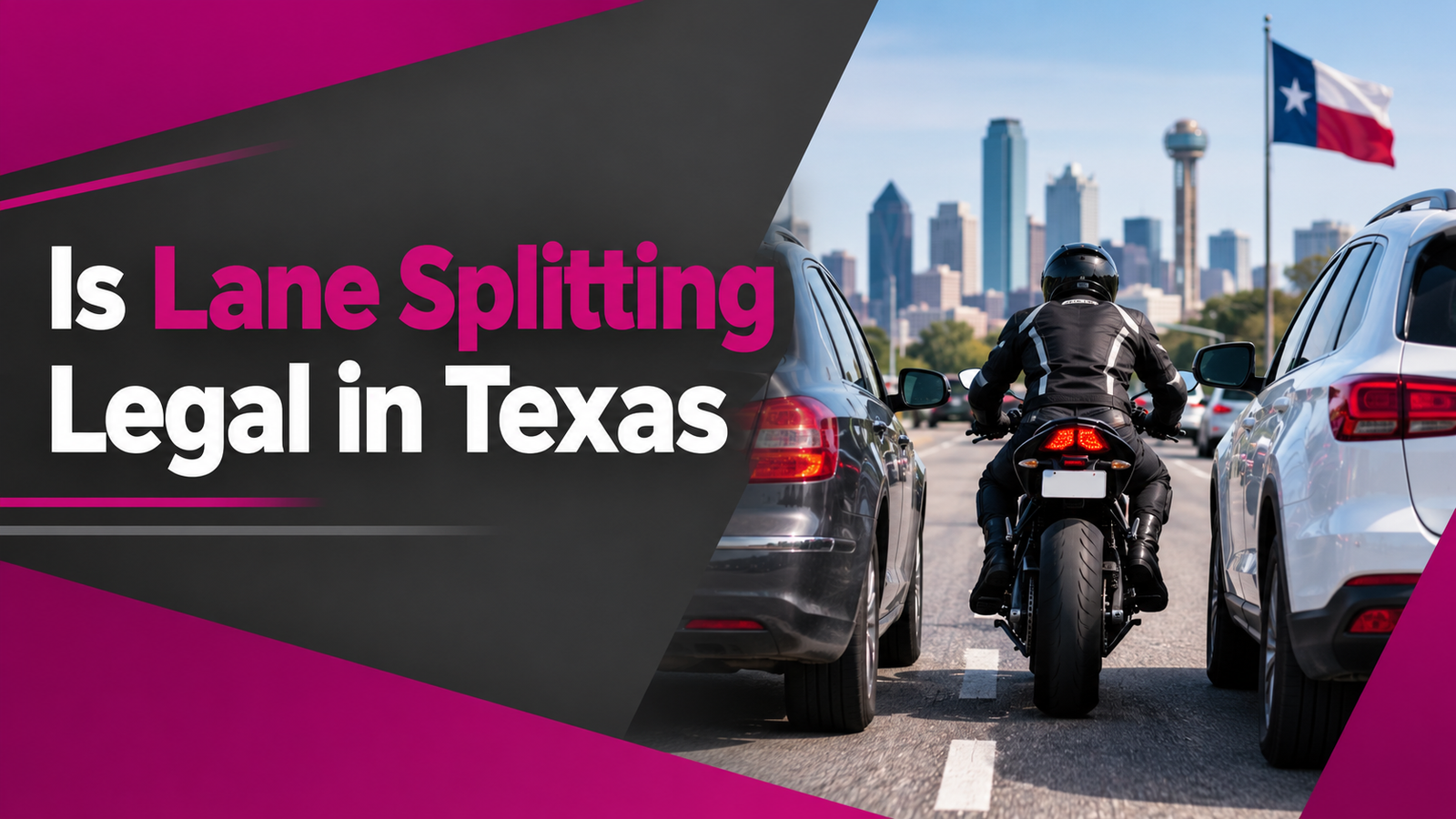
Texas riders face heavy traffic every day on freeways like I-35 and I-10. When cars stack up, the space between lanes looks tempting. Many riders wonder if sliding through can save time without breaking the law. The short answer is clear: is lane splitting legal in Texas? No. It is not legal in 2026, and the same rule covers lane filtering.
This guide explains the exact statute, the difference between common terms, the real penalties, how a citation can hurt an injury claim, and practical ways to stay safer on Texas roads. You will leave knowing what the law allows, what it forbids, and how to protect yourself both legally and physically.
What the Texas Transportation Code Actually Says
Texas made the rule explicit in 2023. House Bill 4122 added Texas Transportation Code § 545.0605. The section remains unchanged in 2026.
The statute says the operator of a motorcycle:
- Is entitled to the full use of a lane. Other vehicles may not crowd a motorcycle out of that space.
- May operate two abreast in a single lane with another motorcycle.
- May not operate more than two abreast in a single lane.
- May not operate the motorcycle between lanes of traffic moving in the same direction.
- May not pass a motor vehicle while in the same lane as the vehicle being passed.
The only exception applies to a police officer performing official duties. Civilian riders have no exception for stopped traffic, slow traffic, or freeway congestion.
You can verify the current text on the official Texas statutes site at statutes.capitol.texas.gov. The ban covers both moving traffic and stopped cars at lights.
Lane Splitting vs. Lane Filtering vs. Lane Sharing
Riders often mix these terms. Clarity matters because Texas treats them differently.
Lane splitting means riding between two lanes of traffic that are moving in the same direction. The motorcycle travels along the stripe or gap while cars around it are in motion.
Lane filtering means moving between or alongside stopped or very slow vehicles, usually at a red light or in jammed traffic, to reach the front.
Lane sharing means two motorcycles riding side by side in the same marked lane.
Texas allows lane sharing (two abreast). It prohibits both lane splitting and lane filtering. A 2025 bill that would have created a limited low-speed filtering exception died in committee. No such exception exists in current law.
Why Texas Banned the Practice
Before 2023 the rule sat in a gray area. Officers sometimes cited riders under the general single-lane rule in § 545.060. Lawmakers closed the gap after hearing safety concerns from law enforcement and insurance groups. Texas roads are wide, speeds are often high, and driver awareness of motorcycles remains inconsistent.
TxDOT data shows hundreds of motorcyclist deaths each year. In 2025 the state recorded roughly 557 to 574 motorcyclist fatalities and thousands of serious injuries. Intersections account for a large share of those crashes. Visibility and unexpected movement play major roles. Legislators decided the risks of riders moving between lanes outweighed any traffic-flow benefits.
Penalties for Lane Splitting in Texas
A violation of § 545.0605 is a Class C misdemeanor traffic offense. That means a fine-only charge. The maximum fine under the general penalty provision is $200. In practice, total cost after court fees often lands between $175 and $300 depending on the county.
Aggressive weaving can lead to a reckless driving charge under § 545.401. Reckless driving carries a fine up to $200, possible jail time up to 30 days, or both. Points appear on your driving record. Multiple moving violations in a short period can trigger license suspension under habitual violator rules.
Insurance companies treat the ticket as a risk signal. Premiums commonly rise 20 percent or more for several years after a moving violation in the improper-lane category.
How Lane Splitting Affects Accident Liability
Texas follows a modified comparative negligence system under Civil Practice and Remedies Code Chapter 33. If you are found more than 50 percent responsible for a crash, you recover nothing. If you are 50 percent or less at fault, your damages are reduced by your percentage of responsibility.
A citation or evidence that you were between lanes gives the other driver’s insurer a clear statutory argument. Adjusters often push more fault onto the rider simply because the maneuver is illegal. That does not mean every claim dies. A driver who changes lanes without signaling, fails to check a blind spot, or drives distracted still shares responsibility. Juries weigh all the facts. Still, the illegal position makes recovery harder and more expensive to prove.
If you are hit while staying fully inside your lane, the statute that guarantees a motorcycle the full use of that lane can work in your favor. Other drivers may not deprive you of that space.
Practical Safety Rules for Texas Riders
Legal compliance and physical safety overlap. Follow these habits:
Stay entirely within a single marked lane unless you are making a proper, signaled lane change. Check mirrors and blind spots every time.
Use the full lane. Ride in the left or right third of the lane so you remain visible and have escape room. Avoid the center if debris collects there.
Keep a safe following distance. Tailgating reduces reaction time and invites rear-end collisions.
Increase rider visibility. Wear high-visibility gear, use daytime running lights or a modulating headlight if legal, and avoid the blind spots of trucks and SUVs.
Watch for left-turning vehicles at intersections. That remains one of the most common crash types for motorcyclists in Texas.
Never ride the shoulder except in the limited situations allowed by § 545.058 (such as avoiding a collision or accelerating to enter traffic). Shoulder riding is not a legal substitute for filtering.
Take a Motorcycle Safety Foundation or Texas-approved course. Some courses also help qualify for the helmet exemption available to riders over 21 who meet the insurance and training requirements.
Common Misconceptions Riders Still Believe
“Everyone does it, so it must be okay.” Enforcement varies by county and officer, but the statute is statewide and clear.
“Stopped traffic is different.” The law does not create a stopped-traffic exception.
“Police do it, so civilians can too.” The statute explicitly exempts only officers on duty.
“A ticket is just a fine.” The long-term insurance and liability costs usually exceed the ticket itself.
“California allows it, so Texas will soon.” Multiple bills have failed. Current law remains the ban.
What to Do If You Receive a Citation
Do not argue on the roadside. Accept the ticket and decide later whether to contest it. For a first offense, some courts offer deferred disposition that keeps the violation off your record if you complete a defensive driving course and stay ticket-free for a set period. Check local court rules. A moving violation conviction still risks higher insurance rates even if the points are deferred.
If the stop involves an accident, document everything. Take photos of vehicle positions, damage, road conditions, and any injuries. Get witness statements. Seek medical care promptly. Contact a motorcycle accident attorney who understands comparative negligence before speaking at length with the other driver’s insurer.
Conclusion
Is lane splitting legal in Texas in 2026? No. Section 545.0605 of the Texas Transportation Code prohibits riding between lanes of traffic moving in the same direction and prohibits passing another vehicle while sharing its lane. The ban covers both traditional splitting and filtering through stopped cars. Two motorcycles may share a lane side by side, and every motorcycle is entitled to the full width of its lane.
Penalties start with a Class C fine and court costs. The bigger risks are insurance increases and reduced recovery if a crash occurs. Stay in your lane, stay visible, and ride defensively. When in doubt about a specific situation or after an accident, consult a Texas attorney experienced in motorcycle claims. Knowing the rules keeps you safer and protects your rights on the road.
FAQs
Is lane splitting legal in Texas traffic?
No. Texas Transportation Code § 545.0605 expressly prohibits operating a motorcycle between lanes of traffic moving in the same direction.
Is motorcycle lane filtering vs lane splitting different under Texas law?
Yes in definition, no in legality. Both are banned. Filtering through stopped traffic is treated the same as splitting moving traffic.
Can motorcycles ride between cars in Texas?
No. The statute forbids operating between lanes or passing while in the same lane as the vehicle being passed.
What is the penalty for lane splitting in Texas?
A Class C misdemeanor fine, typically totaling $175 to $300 with court costs. Aggressive cases can become reckless driving charges.
Are motorcycles allowed between lanes in Austin Texas?
No. The statewide statute applies in Austin, Houston, Dallas, San Antonio, and every other Texas city and county.
Does Texas allow any form of motorcycle lane sharing?
Yes. Two motorcycles may legally ride two abreast in a single lane. Three or more may not.
Will a lane-splitting citation hurt my injury claim?
It can. Texas comparative negligence rules reduce or bar recovery if you are found more than 50 percent at fault. The illegal maneuver gives insurers a strong argument to assign you higher fault.
You May Also Like: TopDog Law Personal Injury Services: Fees, Results, and What Clients Say