 By Legal Radar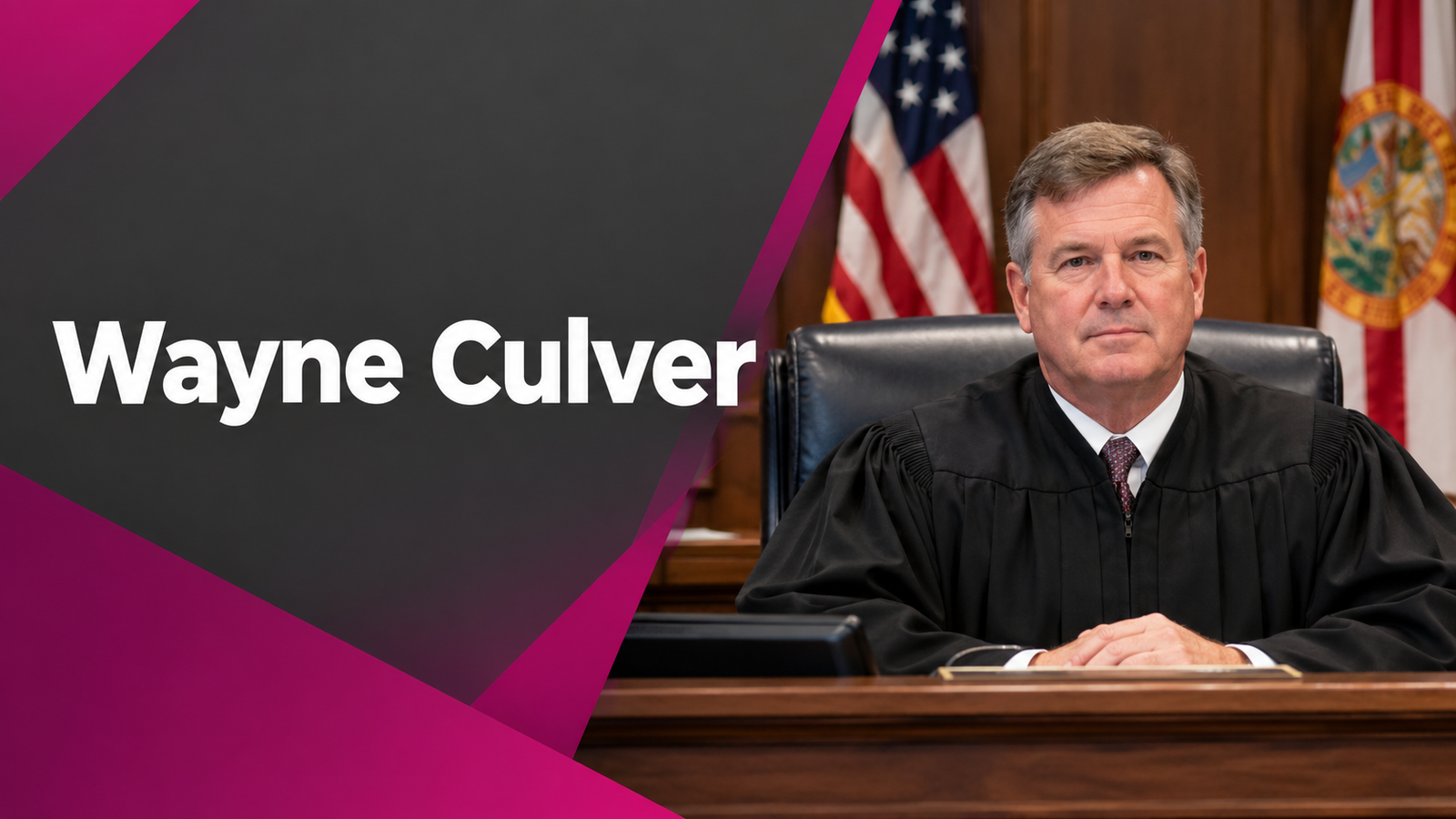
Local courts shape daily life for Florida residents. From traffic matters and small claims to injunctions and misdemeanors, county judges handle high volumes of cases that affect families, businesses, and communities across Seminole County. Understanding the people who serve on the bench helps voters, litigants, and legal professionals follow the Florida judiciary with clarity.
This article offers a factual overview of Wayne Culver, a Seminole County Court judge in the Florida 18th Judicial Circuit. It covers his education, professional path as a prosecutor, private practitioner, and public defender, his 2020 election, courtroom service, and the Florida Supreme Court proceedings that resulted in a 60-day suspension and public reprimand. The goal is straightforward education on his record without advocacy.
Early Life, Education, and Path to the Law
Wayne Culver’s background reflects a working-class Florida upbringing that later informed his public service roles. Campaign materials note that he and his brother were adopted and raised by a Navy family. The family lived in Jacksonville before moving to Seminole County. Culver graduated from Lake Howell High School. He attended the University of Central Florida, earning a Bachelor of Arts in History in 1995 while working in the tire department at Costco and restoring classic cars with family members.
He then attended Suffolk University School of Law in Boston, receiving his Juris Doctor in 2000. After a brief period practicing in Massachusetts, he returned to Florida because of family health matters and prepared for the Florida Bar examination. He was admitted to both the Massachusetts Bar and The Florida Bar in 2001.
These early experiences placed him in Central Florida’s legal community from the start of his career. Official biographies from the Eighteenth Judicial Circuit list his education and subsequent roles without elaboration on personal details.
Professional Legal Background Before the Bench
Culver’s pre-judicial career spanned prosecution, private practice, and defense work within the 18th Judicial Circuit, which covers Brevard and Seminole counties.
From 2001 to 2004 he served as an Assistant State Attorney. In that role he handled criminal cases and gained experience presenting evidence and arguing on behalf of the state.
From 2004 to 2009 he operated a private practice in Seminole County. His work included criminal defense, family law, bankruptcy, dependency matters involving the Department of Children and Families, civil litigation, and real estate transactions. He has described taking cases for clients with limited means.
In 2009 he joined the Office of the Public Defender for the 18th Judicial Circuit and remained until 2020. He practiced criminal law and supervised the misdemeanor division for several years, training newer attorneys on the types of cases commonly heard in county court. This combination of roles—prosecutor, private practitioner, and defense counsel—gave him exposure to both sides of criminal proceedings and a range of civil matters.
Public records from earlier campaigns noted two arrests from the late 1980s when Culver was a teenager. He has publicly acknowledged those incidents, describing one as a prank involving a friend’s car that led to charges of vehicle theft and reckless driving, and stating that he learned from the experience. No arrests appear in the subsequent decades of public reporting.
Election as Seminole County Court Judge
In 2020 Culver ran for and won election as a Seminole County Court Judge. Official circuit materials and candidate profiles list his judicial history as beginning with that election. He took the bench in early 2021. County court judges in Florida handle misdemeanors, traffic cases, small claims, landlord-tenant disputes, certain injunctions, and other matters within the court’s statutory jurisdiction. Caseloads are typically high-volume.
Culver has served in both criminal and civil divisions. As of recent circuit information, he is assigned to Division S (Civil) at the Seminole Civil Courthouse in Sanford. Judicial assistants and case-management procedures are listed on the 18th Judicial Circuit website, along with policies for hearings and dockets. Candidate statements from later election cycles have described resolving large numbers of civil cases monthly.
Judicial elections in Florida are nonpartisan. Culver’s 2020 victory placed him among the elected county judges serving Seminole County residents. Term lengths and subsequent elections follow state rules for county court seats.
Judicial Service and Courtroom Role
As a county court judge, Culver’s docket has included the everyday matters that bring many Florida residents into contact with the courts. Circuit resources provide scheduling information, procedural guidelines for Division S, and expectations for courtroom conduct applicable across the 18th Judicial Circuit.
Supporters and character witnesses in later disciplinary proceedings described him as hardworking and effective in the role outside the specific incidents under review. Official biographies emphasize his prior service as prosecutor and public defender as preparation for the bench. Candidate questionnaires in subsequent election cycles have reiterated a focus on applying the law rather than personal values and on making the process understandable for self-represented litigants.
County court work requires managing high volume while maintaining procedural fairness. Florida’s Code of Judicial Conduct sets standards for patience, dignity, courtesy, and fidelity to the law that apply to all judges.
Florida Judicial Qualifications Commission Inquiry and Supreme Court Proceedings
In early 2022, during Culver’s second year on the bench, two courtroom incidents led to formal charges by the Florida Judicial Qualifications Commission (JQC).
On February 9, 2022, in a hearing involving Samuel Perez and an alleged violation of an injunction requiring completion of a batterer’s intervention program, Culver found Perez in direct criminal contempt, imposed the maximum 179-day jail sentence, and ordered him taken into custody. The JQC found that Perez was not given a meaningful opportunity to be heard on mitigation. A woman in the gallery who attempted to speak was told to sit down or face custody as well. The Fifth District Court of Appeal later determined that the contempt proceeding failed to comply with procedural requirements under Florida Rule of Criminal Procedure 3.830. Perez was released after more than a month in custody pursuant to an emergency habeas petition; the sentence was vacated.
The following day, February 10, 2022, while another hearing was underway, Kevin Newton entered the courtroom and had difficulty finding a seat. Culver raised his voice, ordered him to shut up and sit down, and when Newton explained he was looking for a seat, used profanity and threatened contempt. The JQC found the exchange violated requirements that judges remain patient, dignified, and courteous.
An initial settlement recommending a 60-day suspension was rejected by the Florida Supreme Court, which ordered a full hearing. The JQC hearing panel later found violations of Canons 1, 2, 3B(2), 3B(4), and 3B(7) of the Code of Judicial Conduct in the February incidents (a January 2022 matter was not sustained). The canons address integrity, public confidence in the judiciary, faithfulness to the law, and the duty to be patient, dignified, and courteous.
On November 27, 2024, in Case No. SC2022-0846, the Florida Supreme Court accepted the JQC’s findings and imposed a 60-day suspension without pay and a public reprimand. The Court noted that the conduct toward Newton was sufficiently serious that removal could have been considered, but it also accepted the Commission’s description of “overwhelming” mitigating evidence. That evidence included intense personal stress while Culver served as primary caregiver for his dying father, the absence of any prior disciplinary history as lawyer or judge, testimony from the state attorney, public defender colleagues, and fellow judges that the behavior was aberrational, Culver’s voluntary mental-health counseling and anger-management efforts beginning in 2022, his acceptance of responsibility, and expressions of remorse. The Court expected continued counseling but did not order it, noting constitutional limits on available sanctions.
The public reprimand occurred in February 2025 before the Florida Supreme Court. Chief Justice Carlos G. Muñiz administered the reprimand, describing the conduct as unacceptable and warning that future similar conduct would not be treated lightly. Culver completed the suspension and returned to judicial duties. No additional disciplinary actions have been reported in subsequent public coverage.
Subsequent Elections and Public Record
Culver has sought reelection. In the 2026 cycle he appeared as the incumbent for Seminole County Court Judge Group 6, facing challengers in the nonpartisan primary. Candidate information published by news outlets and voter guides repeated his education, prior roles as assistant state attorney, private practitioner, and assistant public defender, and his service since 2020–2021. Campaign websites emphasized local roots and experience on both sides of criminal cases.
Official circuit pages continue to list him with contact information for his judicial assistant, division assignment, and procedural resources. The public record therefore includes both the disciplinary disposition and the continuation of service after the suspension period.
Context Within Florida’s Judicial Accountability System
Florida’s system for judicial discipline involves the Judicial Qualifications Commission investigating complaints, conducting hearings, and recommending discipline to the Florida Supreme Court. The Court retains final authority to accept, reject, or modify recommendations. Available sanctions include reprimand, fine, suspension with or without pay, and, in serious cases, removal. The process is designed to balance accountability with due process for the judge.
Public confidence in the judiciary depends in part on visible adherence to the Code of Judicial Conduct. Cases involving intemperate courtroom behavior are periodically reported across circuits; each is evaluated on its specific facts, including aggravating and mitigating circumstances. In Culver’s matter the Court and Commission treated the 2022 incidents as serious while accepting evidence that they were limited in time and linked to personal hardship, with subsequent remediation.
For residents and practitioners in Seminole County, the practical result is a sitting county court judge whose record contains both extensive prior practice experience and a formal disciplinary outcome that has been publicly documented and resolved.
Key Takeaways on Wayne Culver’s Record
Wayne Culver’s path runs from Central Florida education and early legal roles through prosecution, private practice, public defense, and election to the Seminole County Court bench in 2020. He has handled high-volume dockets in criminal and civil divisions. The 2022 courtroom incidents led to a multi-year JQC process, a 60-day unpaid suspension ordered in November 2024, and a public reprimand in February 2025. Mitigating factors centered on personal circumstances and subsequent remedial steps were accepted by the Florida Supreme Court. He returned to service and has continued to appear on the ballot and on official court directories.
Readers interested in local judicial matters can consult primary sources for the most current information. Official court websites, Florida Supreme Court opinions, and The Florida Bar resources provide the authoritative record.
For the latest on Seminole County court operations or specific case information, visit the Eighteenth Judicial Circuit website or contact the appropriate clerk’s office. Voters and court users benefit from reviewing official documents rather than secondary summaries alone.
Frequently Asked Questions
Who is Wayne Culver?
Wayne Culver is a Seminole County Court Judge in Florida’s 18th Judicial Circuit. He was elected in 2020 and has a prior background as an assistant state attorney, private practitioner, and assistant public defender.
What is Wayne Culver’s educational background?
He earned a B.A. in History from the University of Central Florida in 1995 and a J.D. from Suffolk University School of Law in 2000. He was admitted to the Florida and Massachusetts Bars in 2001.
When was Wayne Culver elected judge?
He was elected Seminole County Court Judge in 2020 and began serving in early 2021.
What led to the Florida Supreme Court suspension?
Two courtroom incidents in February 2022 involving intemperate conduct, including a contempt proceeding that was later found procedurally deficient and use of profanity toward a person in the courtroom, resulted in JQC findings of judicial-canon violations. The Florida Supreme Court imposed a 60-day suspension without pay in November 2024 and a public reprimand in February 2025.
Did the Florida Supreme Court remove Wayne Culver from the bench?
No. The Court imposed a 60-day suspension without pay and a public reprimand, citing mitigating evidence including personal hardship, lack of prior discipline, remorse, and remediation efforts.
Is Wayne Culver still serving as a judge?
Yes. After completing the suspension he returned to duties and has been listed on official circuit directories and subsequent election materials.
Where can I find official information about Wayne Culver’s court?
The Eighteenth Judicial Circuit Courts website (flcourts18.org) provides biographies, division assignments, policies, and contact information for judicial assistants.